# How Funda Handles Packaging Design During Product Sourcing
Most delays in a first production run have nothing to do with the product. The tooling is finished, the samples are approved, the factory has capacity booked, and then the whole thing sits for three weeks because the artwork arrived as a JPG, or nobody has written the French copy for the Canadian warehouse yet, or the barcode landed across a crease and the printer refuses to run it.
Packaging is where product development, branding, compliance, printing and logistics all end up in the same file. When that file is wrong, nothing moves.
So it's worth setting out how packaging actually gets handled on our side, and being specific about where our responsibility ends. We confirm dimensions, we issue the die line, we flag the compliance questions that need answering before anything is printed, we introduce designers when a client doesn't have one, and we arrange proofs where the format can be proofed honestly. What we don't do is open a client's artwork and start moving things around, and there's a good reason for that which we'll get to.
Quick answer
Packaging starts from the product's final dimensions, not from a logo. Our packaging team issues a die line built on those dimensions and the chosen structure; the client's designer builds the artwork on that die line and returns a print-ready file. In parallel we send destination-market and category compliance reminders, which the client verifies with a qualified professional. Paper packaging gets a physical proof before production. Most plastic packaging can't be proofed economically, so it gets a rigorous digital sign-off instead. Funda coordinates the handoffs and controls the final file version. The client owns the brand, the claims, and the approval.
Dimensions come before artwork
Nobody should be building final artwork until the product dimensions are locked, and locked means the physical sample is signed off, the pack quantity is decided, and nobody is still debating whether the handle comes down 3mm.
That last one isn't hypothetical. A 3mm change in height moves the crease position on all four side panels, and if the designer has already balanced the front panel against the old dimension, you're buying a full artwork round to save a millimetre of material. Worse, a die is a physical object: steel rule bent into a plywood board. Once it's cut, it's cut. Changing the structure later means new tooling, new cost, and another week you didn't plan for.
Brand exploration can absolutely start earlier. Colour, typography, photography direction, competitor positioning — all of that can run while the product is still in development. It's only the die-line artwork that has to wait.
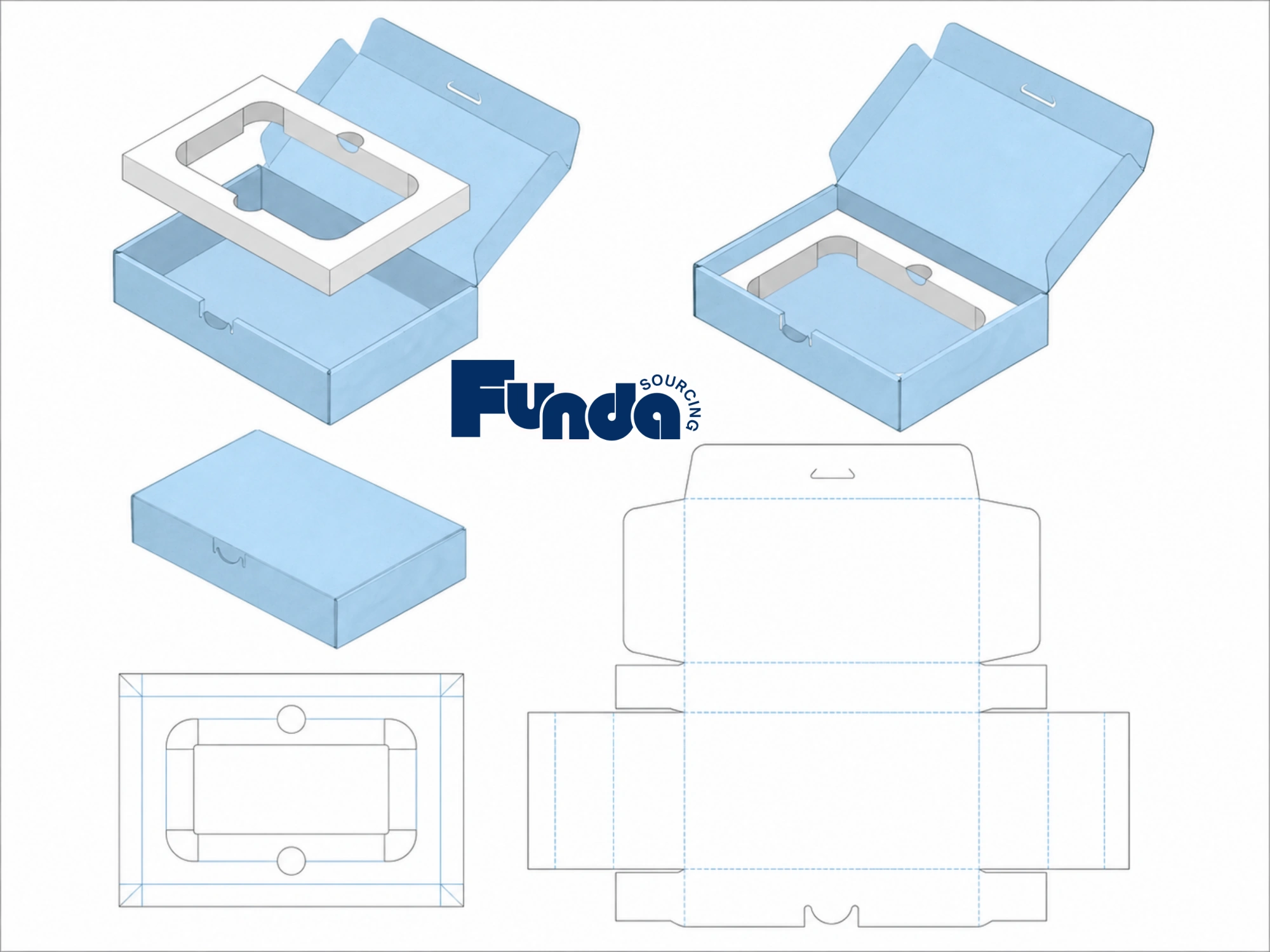
Before we request a die line, we confirm the finished product dimensions and weight, how many units go in one retail pack, how the product sits inside, whether an insert or tray is needed, the material, the opening method, and whether the package needs a window, hang hole, zipper or tamper-evident feature. We also ask what has to fit inside besides the product, because instructions and accessories are what usually break a layout late in the process.
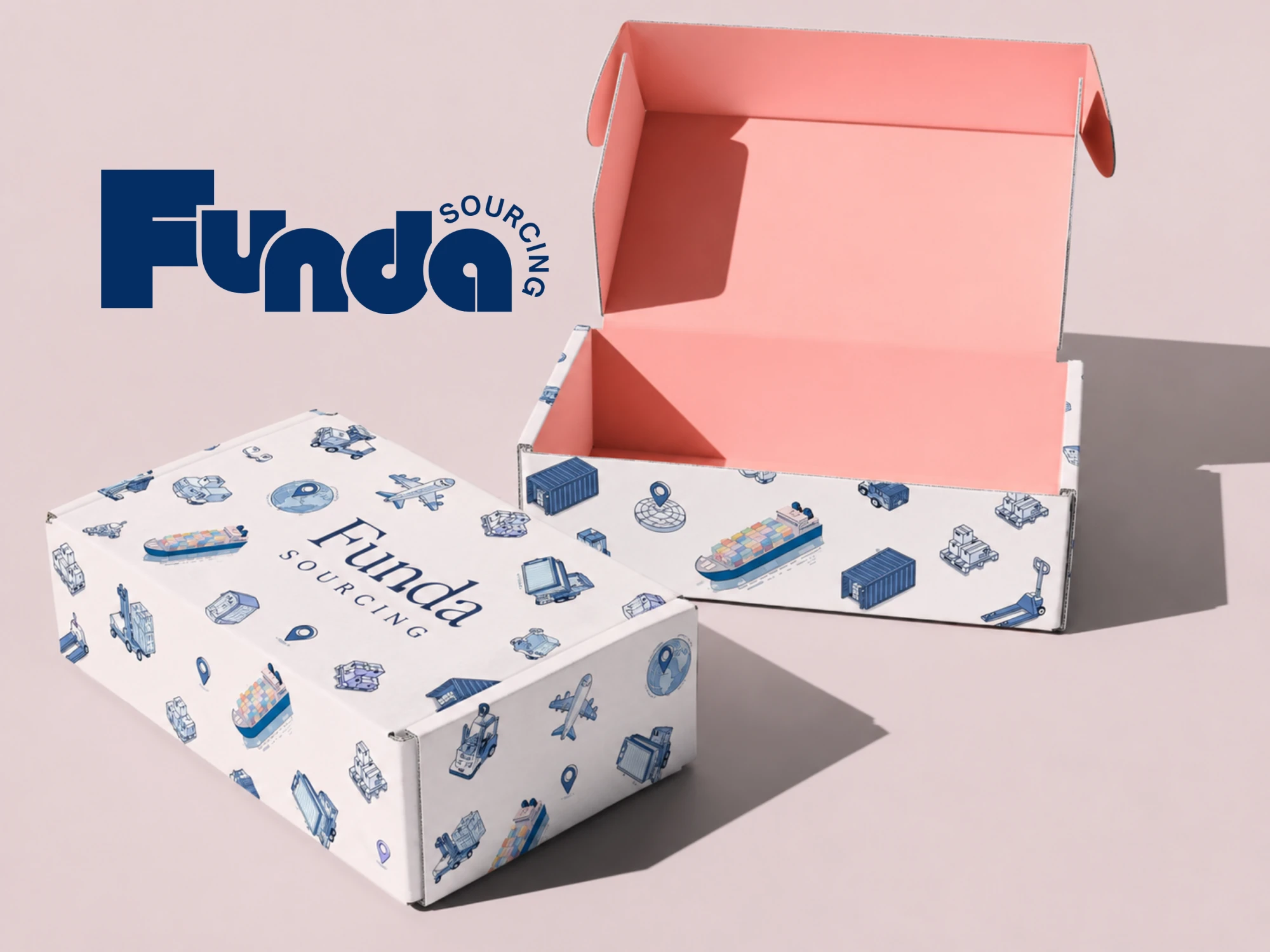
Structure and material aren't neutral, either. Kraft board eats colour, so anything printed on it comes out warmer and darker than it looked on screen. Solid dark coverage on E-flute or B-flute corrugated will show flute lines through the ink. A rigid box is assembled by hand and behaves nothing like a folding carton. None of that is a problem — it's a constraint, and your designer needs it before they start rather than after.
Packaging also feeds straight into logistics planning. A retail box that's 5mm deeper can drop your master carton count, which changes freight cost per unit for the life of the SKU.
The die line: what we send and what it's for
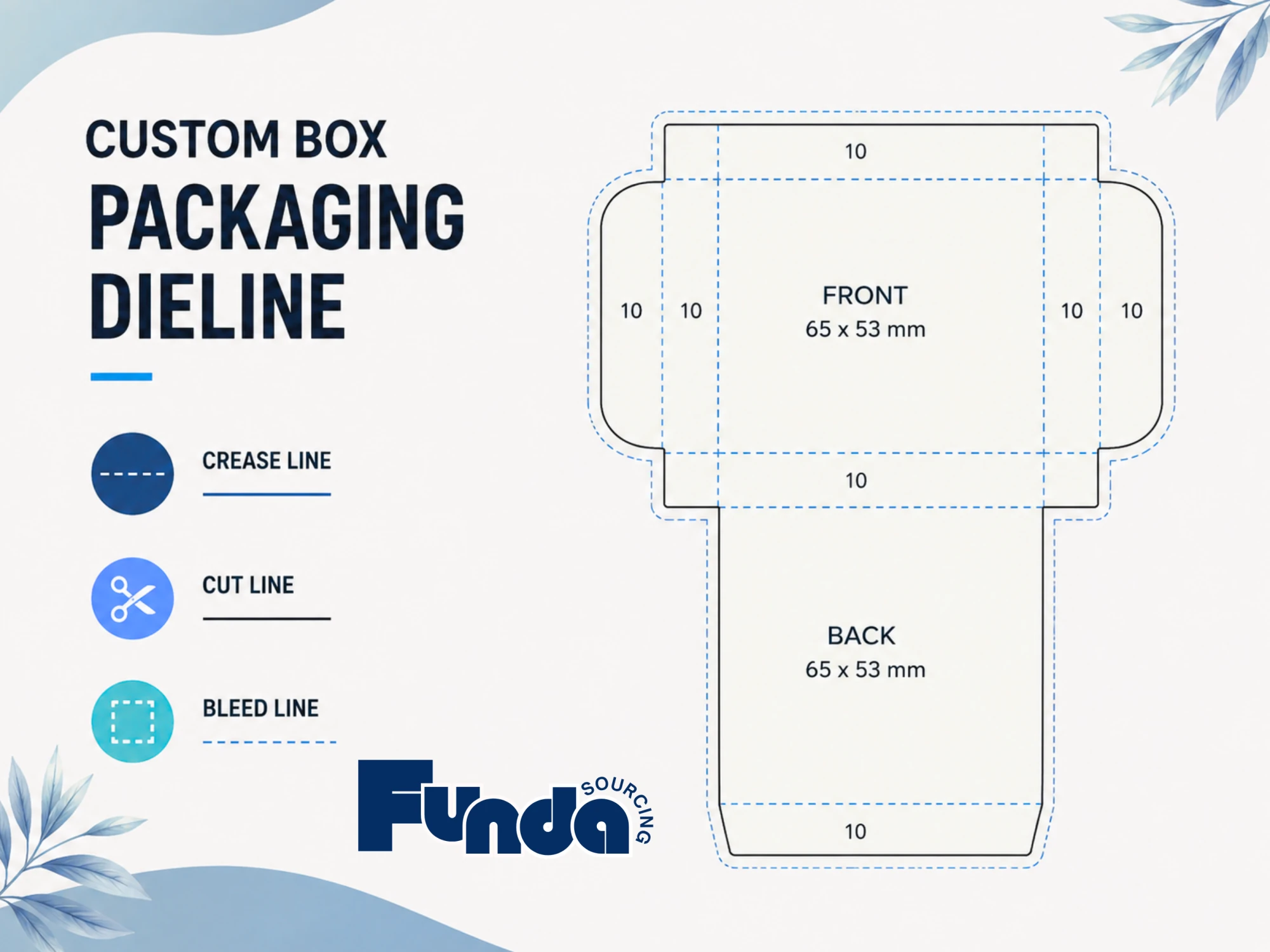
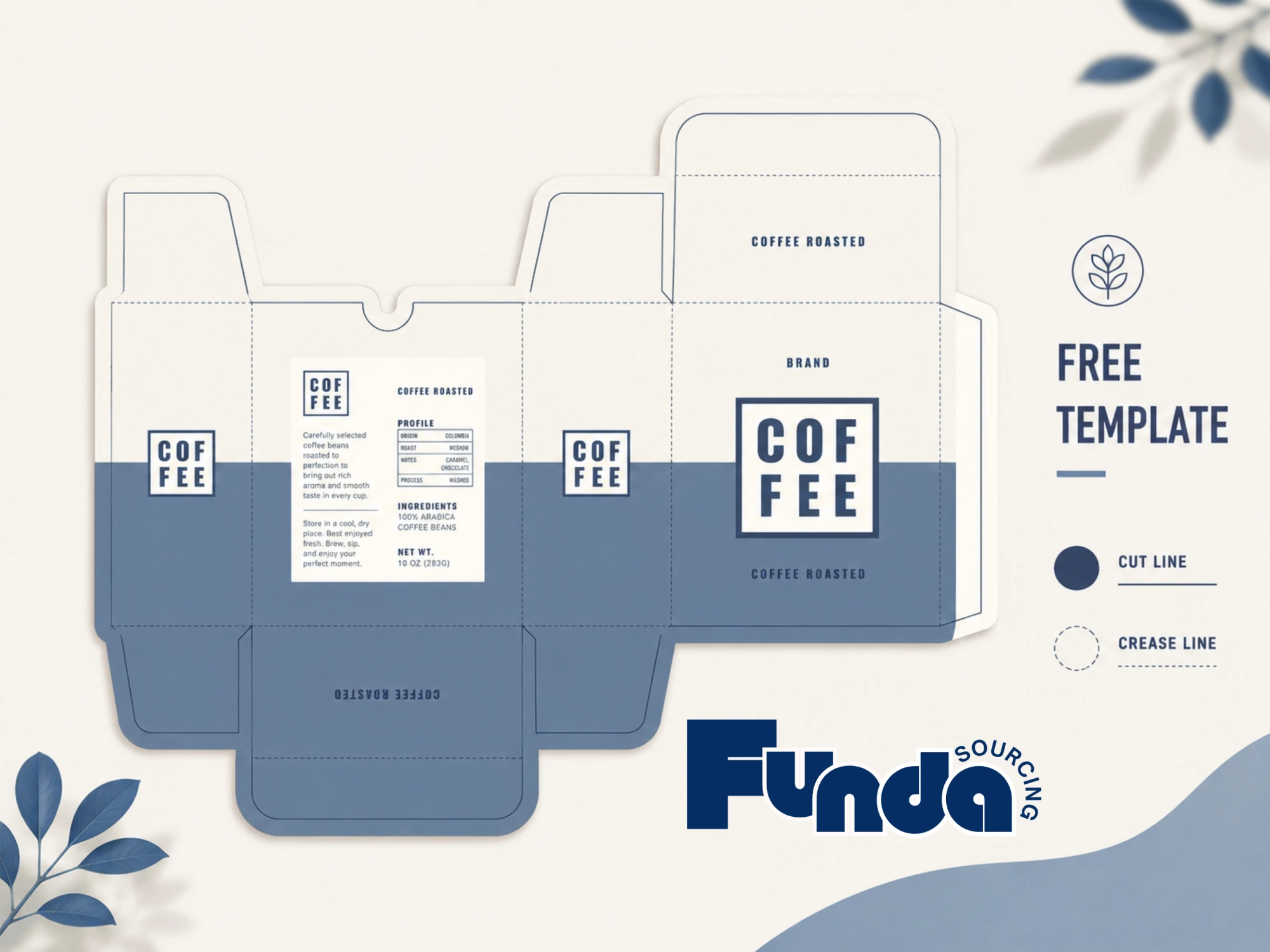
Once structure, dimensions and material are settled, our packaging team issues the die line — the flat, unfolded production template at 1:1 scale.
We normally supply a layered vector file with a reference PDF. The layers matter, because they're the instructions:
- Cut line — the profile the steel rule follows
- Crease/score — where the board folds
- Bleed — typically 3mm past the cut, so trim variance doesn't leave a white edge
- Safe zone — usually 4–5mm inside cut and crease lines, where nothing critical goes
- Glue flaps and dust flaps — surfaces that get adhesive or tuck under, so no artwork lives there
- Panel labels — front, back, left, right, top, bottom, so nobody guesses orientation
- Finishing layers — foil, emboss, spot UV, each separated and named
The printer's own spec is always final, since bleed and safe-area requirements shift between structures and printing processes. But those are the defaults we work from.
We also mark the awkward areas directly on the file: the panel that disappears under a tuck, the crease a logo shouldn't cross, the seal zone that can't carry text, the section a closure label will cover. The whole point is that the designer builds into the real structure instead of designing around a guess.
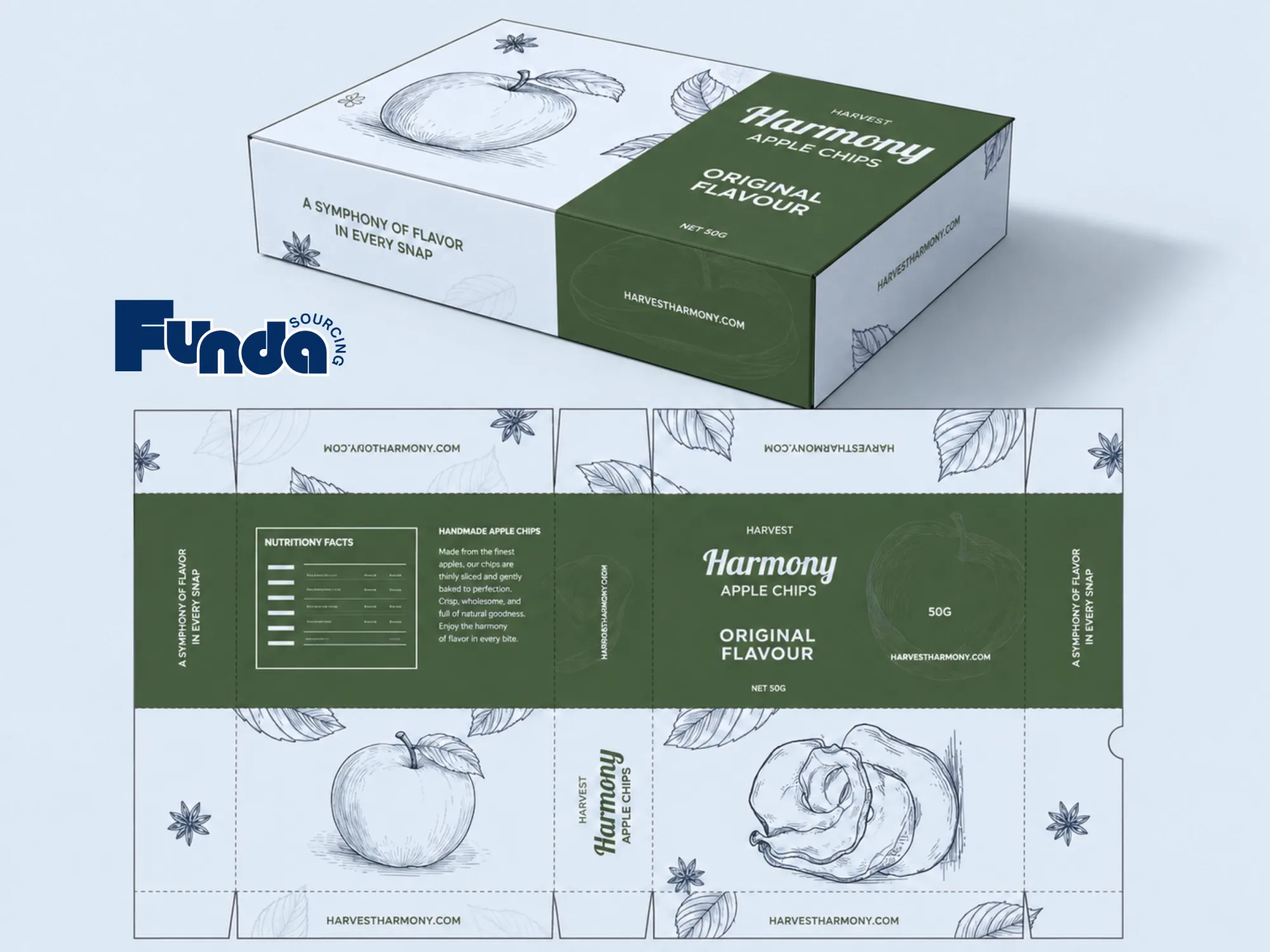
Rejected files fail for a short and predictable list of reasons — artwork built on a generic template, the die line flattened into an image, a forgotten fifth panel, background art that stops at the cut line instead of running into the bleed, text sitting on a fold, RGB colour, or a barcode across a crease. On barcodes specifically: keep the quiet zones clear, don't shrink below roughly 80% magnification, and never reverse it. Light bars on a dark field won't scan reliably no matter how good it looks.
Compliance: we flag, you verify
Funda is a sourcing agent, not your regulatory consultant. We don't sign off on labelling and we don't decide whether a claim is legally acceptable.
What we do is run a first filter based on product category, intended use, claims, destination market and sales channel, then send the relevant questions and official references early enough that the client can investigate properly. Depending on the product, that filter typically covers identity and net contents; the responsible party — manufacturer, importer or dealer, and their address; ingredient or material declarations; warnings, directions and traceability such as lot codes and date coding; country-of-origin marking; and language requirements for the destination. Regulated categories add their own layer, whether that's cosmetics ingredient naming, food-contact documentation, children's product warnings, or poly-bag suffocation warnings for US retail.
That's a prompt list, not legal advice. But most packaging disasters we've seen didn't start with someone ignoring a rule. They started with a founder who didn't know the rule existed.
Medical devices into the United States
When a client tells us a product is a medical device, the first question is not whether the factory has an "FDA certificate." That phrasing causes more confusion than it resolves, because the FDA does not issue device registration certificates, and establishment registration and device listing don't mean a facility or device has been approved, cleared or authorised. "Registered," "cleared" and "approved" are three different things, and only one of them belongs on a box in any given situation.
The packaging questions that matter more: what the device's intended use is, what classification applies and whether the applicable pathway is exemption, 510(k), De Novo or PMA, what has to appear under general device labelling requirements in 21 CFR Part 801, whether a UDI applies and needs to be carried on the label and packages, and whether the marketing copy on the front panel matches what the device is actually authorised to do.
There's a structural consequence people miss. Directions for use, warnings, symbols and traceability information take physical space. A device that needs a full IFU may not fit the elegant minimal carton the designer had in mind, and finding that out after the layout is approved is an expensive way to learn it. We raise the space question at the die-line stage for exactly this reason.
Moving US inventory into Canada
A client had inventory in a US warehouse and wanted to move part of it to a Toronto 3PL to serve Canadian orders. On a logistics spreadsheet that's an inventory transfer. On a packaging spreadsheet it's a market entry.
Their box had been designed for the US and didn't contain a word of French. For prepackaged consumer products under Canada's Consumer Packaging and Labelling Act, product identity generally has to appear in both English and French, with other elements and exemptions depending on the category. For medical devices sold to the general public, Health Canada requires most specified label information in both official languages — see its guidance on assessing compliance with the Medical Devices Regulations and its import notification guidance, and note that importers and distributors may separately need a Medical Device Establishment Licence.
We flagged it before the transfer, which is the entire value of the flag. Had it moved first, the options would have been over-labelling several pallets by hand at the 3PL's hourly rate, shipping it back, or writing it off. Instead they ran a Canada-specific SKU on the same print job at marginal cost.
One thing worth understanding: adding French is not a translation task. Copy roughly doubles, which means font sizes drop, warnings relocate, and instructions that fit one panel in English may need an insert. Tell us the real destination markets before the layout is approved, not after.
No design team yet? Two routes
Plenty of early-stage clients arrive with a good product, a logo, a few competitor screenshots and a sentence like "clean, premium, sustainable, but not expensive-looking." That's enough to start a conversation and nowhere near enough to print.
For startups and smaller launches we introduce independent packaging designers we've worked with for years. They understand die lines without being taught, they're priced for a brand that's launching rather than scaling, and several now use AI tools during concept development — generating high-level visual directions quickly, then building two or three moodboards for the client to react to. That's genuinely useful, because it compresses the "I'll know it when I see it" stage from three weeks to three days. A founder who can't articulate the difference between clinical minimalism and modern natural wellness can point at one of three boards immediately.
The production artwork is still built by hand, in vector, on the die line. AI doesn't produce a print-ready file, and anyone claiming otherwise hasn't sent one to a printer.
For brands with bigger positioning ambitions — national retail, a multi-SKU system, a category where the packaging is the product experience — we introduce branding studios in New York and London. They cost meaningfully more, the process runs longer, and the work is outstanding. We recommend based on where the brand actually is. Sending a pre-launch startup to a London studio does them no favours, and sending a funded premium brand to the cheapest available freelancer does them fewer.
Print-ready only, and why we don't touch the file
We accept print-ready files. We don't edit, resize, recolour, retouch or "just fix" a client's artwork. If a comma is wrong, the file goes back to the designer.
Here's why, in the form of a sequence we've watched happen elsewhere. The designer sends `Box_Final_v7.ai`. The packaging supplier nudges one line away from a crease. Someone else corrects a spelling mistake. The file gets opened on a machine without the original typeface, and the substitute reflows the text. An old SKU's barcode is still sitting on a locked layer nobody unlocked. It prints. Every single person in that chain believed they were being helpful, and the box is still wrong — and now nobody can say which change caused it.
Related: these are not file names. `FINAL.ai`, `FINAL2.ai`, `FINAL_NEW.ai`, `FINAL_NEW_USE_THIS_ONE.ai`. Every production file should carry an SKU, a revision number and a date, and the approved PDF should match the approved editable file.
What print-ready means in practice: vector or press-quality PDF at 1:1 on the supplied die line, die line intact on its own non-printing layer, CMYK with Pantones specified separately, fonts outlined or embedded, images 300 dpi at final size, bleed and safe areas per the printer's spec, finishing effects on labelled layers, approved barcode with clear quiet zones, and a flat PDF showing intended appearance. We check the file against the supplier's requirements and come back with what's missing. We just won't be the ones fixing it.
What can be proofed, and what can't
Paper packaging can be sampled properly, and we push for it: folding cartons, kraft boxes, mailers, paper bags, sleeves, hangtags, insert cards. A blank structural sample confirms fit and folding; a digitally printed proof shows the artwork on the real substrate at real size. Put the actual product inside it. Approving an empty box tells you much less than you think.
Print at 100% and hold it. Artwork looks generous on a 27-inch monitor and then the side panel turns out to be 45mm wide, the body copy is unreadable, and the QR code won't scan. One caveat: a digital proof will shift from an offset production run, so if a colour is critical, specify a Pantone and we'll pull chips.
Plastic is a different situation, and this is the part clients underestimate. Poly bags, poly mailers, printed film, shrink sleeves and most plastic-substrate labels are printed flexo or screen, which means physical plates or cylinders per colour. The setup cost is effectively identical whether you run one piece or ten thousand, so factories won't produce a one-off, and often the first physical item anyone sees comes off the production run itself.
When a sample does exist, be clear about what it proves. A material sample confirms thickness and hand feel, not colour. A digital mockup confirms layout and copy position, not production ink or lamination. A 3D render confirms visual direction and essentially nothing about manufacturability. Treating a mockup as a full approval is how brands end up with the right design in the wrong finish.
So for anything plastic, approval happens on screen and it has to be forensic. Check the copy character by character, scan the barcode straight off the PDF, verify the SKU, net contents, ingredients, warnings, directions, importer address, website, sizing chart, both language versions, and the small print nobody has read since version three. Once that file goes to production it becomes a pallet of whatever it says.
We've never regretted asking a client to review a proof one more time. We've seen the alternative.
The workflow, in order
1. Lock the product — dimensions, weight, pack quantity, physical sample approved 2. Agree structure and material, including opening method and internal protection 3. Confirm every destination market the SKU will actually be sold in 4. Our packaging team issues the layered die line 5. The client's designer, or one we introduce, builds artwork on that die line while we send category and market compliance flags for the client to verify 6. Print-ready file returns to us; the packaging supplier runs a technical review against material and process 7. Paper gets a physical proof, plastic gets a documented digital approval, and the client signs off on a specific version number 8. The approved file is archived and released to production, and packaging is written into the quality inspection criteria
For related detail, see our guides to private label packaging, sample approval before bulk production, and quality check planning.
FAQ
Does Funda design packaging? No. We supply the die line, coordinate the supplier, arrange proofs and control the production handoff. Design is done by your designer or one we introduce. It keeps accountability clean.
Can the factory design our packaging? Some offer basic artwork support, which is fine for simple logo placement. The factory should control manufacturable structure; a designer should control the brand.
How long does packaging take? From locked dimensions to approved proof, usually two to four weeks depending on artwork turnaround. Production runs after that, typically 10–20 days depending on structure and finishing.
Does Funda approve compliance? No. We flag likely requirements and point to official sources. Confirming them is the client's responsibility, with qualified advice in the destination market.
Can we use the same packaging in the US and Canada? Don't assume it. Language, product identity, importer information and category rules need review before inventory is transferred into Canadian distribution.
Can we sample a printed poly bag before production? Rarely as a true production equivalent. Plan on a careful digital approval, and ask the supplier explicitly what any sample does and doesn't represent.
When should packaging design begin? Brand concepts during product development. Final die-line artwork after dimensions, pack quantity, structure and destination markets are locked.
---
Working on packaging for a new product or a new market? Send Funda your product dimensions, target markets, expected quantity and current packaging direction. We'll identify the right structure, issue the die line, flag what needs resolving, and carry the approved file through sampling into production.
Working on packaging for a new product or a new market?
Send Funda your product dimensions, target markets, expected quantity and current packaging direction. We will identify the right structure, issue the die line, flag what needs resolving, and carry the approved file through sampling into production.

